What Four Years at Bansko Taught Us - By Ryo Osera, Co-founder of Colive Fukuoka
Published:
A co-founder's reflection from Bansko Nomad Festival on belonging, inclusion, and "harmony is to be valued," and why this October in Fukuoka is built for everyone. Early Bird 30% off ends July 15.
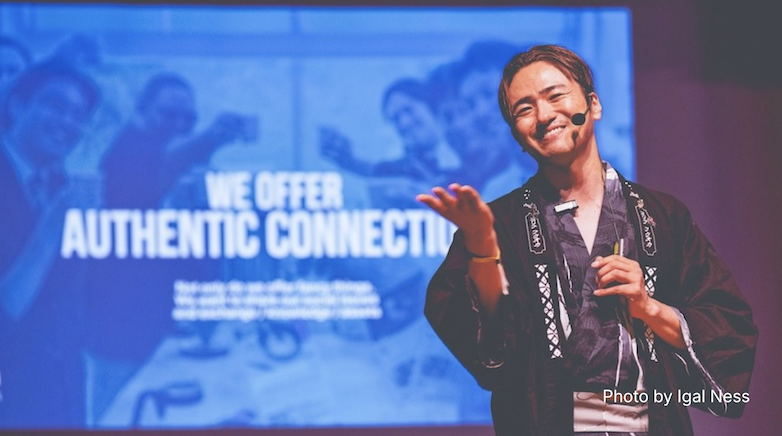
I went back to Bansko Nomad Fest, one of the biggest digital nomad gatherings in the world. Four years on, I've become the guy who tells the first-timers where the laundromat is and where to find good coffee. Somewhere across those years, this little mountain town in Bulgaria turned into a second home for me. That feeling, belonging somewhere far from where you grew up, is most of the reason I love this life.
It's also the feeling we're building in Fukuoka.
What we brought to Bansko: Co-creation

I wasn't there as a tourist, and not only as a sponsor. Our team showed up as Co-creators, helping build the festival itself, not just appear at it. From the spot right beside the Park Stage, among roughly 500 nomads from more than 100 countries, we brought nearly 20 people from Japan and shared the places we love over fresh green tea and the incense of Japanese Cider Tree: Fukuoka, Osaka, Nagasaki, Kotohira. These are the parts of Japan most people never put on their itinerary.
Plenty of people say they've been to Japan, but few make it as far as Fukuoka. By some counts, only about 5% of international visitors do. And here is what moved me most: it was our own Colive Fukuoka alumni introducing each other to Fukuoka, and to other corners of Japan, passing on the places they had come to love. That is a memory I'll hold onto.
Are we actually welcome here?

I want to be honest about something most people in our position don't say out loud.
Walking into a European nomad gathering as Japanese, there to talk up our own cities, takes a certain bravery. "When in Rome, do as the Romans do," the saying goes, and there we were, a group of Japanese arriving together in a place with a different language and culture, aware that our presence might feel unfamiliar to some. That awareness never quite leaves you.
Even in a room full of self-described global citizens, a harder question sits underneath: as Asians, are we really safe inside Western culture? That's a small, private confession on our part. And the answer Bansko gives, four years running and unchanged, is yes. Through the genuine hospitality of everyone involved, from the owners on down, this is a place that welcomes you warmly whatever country you come from. Year after year, it has eased our nerves and left us feeling braver and more supported.
That immediate sense of inclusion is what Bansko taught us, and what I'm set on recreating in Fukuoka. My goal is a place where you feel you belong from the very first step, no matter where you come from.
I'm hugely grateful to the Bansko team for teaching us that again. And if Bansko meant as much to you, their 2027 tickets just went on sale. This world has never been zero-sum: when one of these communities grows, all of us do.
A community where you feel safe, wherever you come from

What I learn from Bansko changes every year. This year the lesson was about inclusion: how essential it is, how steady it has to be, and how much care it deserves from anyone who builds communities for a living.
And it runs both ways. Just as we can feel that flicker of anxiety coming from Asia to Europe, I suspect some of the people thinking about Japan feel it too. When one-sided headlines travel fast, someone reading from far away might catch a story that suggests Japan is closing its doors, and start to wonder whether they'd really be welcome here. Not as a tourist passing through, but as a nomad who wants to live and work next to locals for a while.
That worry is exactly what Colive Fukuoka exists to answer.
和を以て貴しとなす: "Harmony is to be valued"
I made this the theme of my talk last year, and I keep coming back to it.
"Wa o motte tōtoshi to nasu," harmony is to be valued, is written into Article I of Japan's first constitution, drafted around 1,400 years ago. It doesn't mean everyone should be the same. It means people who are different can choose to respect, support and contribute to one another.
That's the kind of place I want Colive Fukuoka to be, and to stay: somewhere every participant, across every border and culture, stands on equal ground. Bansko reminded me how rare that is, and how worth protecting. In Fukuoka I want us to live it out through real diversity, and through what sociologists call the strength of weak ties, the surprising power of the new, loose connections a place like this makes possible.
Now, Fukuoka this October

Everything I felt in Bansko is going straight into Colive Fukuoka 2026, which runs every October alongside the global startup conference RAMEN TECH.
Last year our community brought together 57 countries and more than 500 attendees. It's already one of Asia's most ambitious gatherings of global citizens. This year goes deeper: better programming, stronger founders, and the partnerships I started building back in those mountains.
Go beyond tourism in Japan, and invest in your growth. Come to Fukuoka, a city that's fast becoming one of Asia's strongest startup hubs, to build something and belong, not just to pass through.
One date to remember: July 15
If you've read this far, you can probably already picture the room.
So here's where it gets practical. Early Bird tickets for Colive Fukuoka 2026 are 30% off until July 15. After that the price goes up and the window closes.
If you want to be in Fukuoka this October, in a community built to welcome you wherever you're from, lock it in now, while it's 30% off.
→ Claim your Early Bird, 30% off until July 15
See you in Fukuoka this October.
Ryo Osera, Co-founder, Colive Fukuoka